
WHEN a BBC dragon targets a blunt “get a grip” message to the legal sector and also to working people who are already uncertain about the benefits of AI, you prick up your ears.
Piers Linney made the controversial-sounding statement on the main stage at Tech Show London 2026.
The remark drew attention – but it reflects a broader mood across the technology sector.
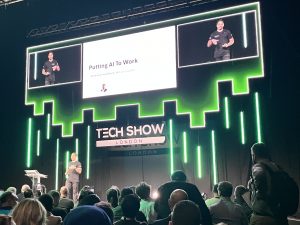
How to put AI to Work – by Mark Chapman, the-eConsultant – at Tech Show London
It was reminiscent of Elon Musk who made (public relations) headlines wielding a chainsaw to announce plans to cut US government staffing. This came after his widely trumpeted cuts at Twitter – presumably AI-led.
Such stage-managed impatience is a clear, aggressive, shout-out to organisations: speed matters.
The reality for organisations, however, is subtler. Fast is not enough – it must be meaningful !
At the operational frontier, AI can handle much of the heavy lifting:
- Automating knowledge work
- Processing large datasets
- Reactivating dormant revenue opportunities.
Some estimates suggest AI can already handle a significant portion of routine knowledge work – but only when deployed carefully and with human oversight, i.e. legal work, other high-volume documentation.
Mistakes, however, are real + costly. Energy consumption is rising, untested applications can be dangerous – and even basics such as accuracy, or truthfulness – is a major issue; just ask anyone who’s used ChatGPT over a reasonable length of time.
So, let’s slow this down.
For leaders, the rules are simple:
- Deploy AI where it works and produces ROI.
- Keep humans involved to mitigate risk.
- Understand the full cost, including environmental and reputational impact.
- Don’t adopt AI just to follow the crowd; focus on outcomes for customers and staff.
Businesses that navigate this effectively combine agile structures, clear priorities – and human insight.
Appropriately managed digital transformation helps organisations do this efficiently, lowering overheads and other costs while keeping teams capable and engaged.
Large organisations and VC-backed ventures often carry high overheads and complex layers, which inflate costs and slow execution.
For boards and investors, the challenge is not whether AI will reshape organisations, but how to capture its benefits without adding unnecessary cost, risk – or complexity.
My experience in digital transformation and marketing allows identification of where AI and process improvements deliver real impact and streamline operations while preserving the human knowledge and creativity that machines cannot replace.
‘This combination is what makes ‘the eConsultant’ a strong contributor at executive level – with a track record helping organisations move quickly, stay lean, and ensure technology works for people – not just metrics’
The real question for leaders is where AI genuinely adds value – and where it doesn’t …